
Summary:
Timber Overview and Characteristics
Hygroscopic Behavior
Wood is a hygroscopic material. This means that it will release or absorb moisture from the air until its MC (Moisture Content) has stabilized in relation to the moisture content and temperature of the surrounding air.
CELLULAR
/ Seljula
/ Adjective: cellular
Relating to or consisting of living cells.
"Cellular proliferation"
Expansion and contraction - sun and rain - humidity changes:
Timber will absorb and release moisture.
DECKING OPTIONS & SPECIFICATIONS SUMMARY
Pine
Other Names: Pinus Elliotti, Pinus Patula, Pinus Radiata
Average Density: 450kg/m³
Durability: Non-durable
Uses: Structural Timber, Furniture, Plywoods, Flooring, Ceiling, Laminated Beams, Mouldings
Meranti
Other Names: Light Red/ Red Seraya
Average Density: 385kg – 755kg/m³
Durability: Non-durable
Uses: Joinery, Veneer & Plywoods, Counter Tops, Cabin Fittings, Decorative Work
Balau
Other Names: Selangan Batu
Average Density: 850kg – 1155kg/m³
Durability: Very Durable
Uses: Heavy Construction, Bridges, Wharves, Railway Sleepers, Framework of Boats, Heavy-Duty Flooring
Saligna
Other Names: Eucalyptus Grandis
Average Density: 640kg/m³
Durability: Non-Durable
Uses: Joinery, Counter Tops, Laminated Beams, Furniture
Natural Durability Grouping
Very Durable - Exceeding 10 Years
Durable - 5-10 Years
Moderately Durable - 2-5 Years
Non-Durable - 0-2 Years
The placement of any timber in any of these four groups is based on its performance in "graveyard" testing. This method of testing entails the monitoring of test-sticks measuring 50x50x600mm buried in test grounds. The number of years that the test-sticks can last is the basis for the grouping.
Great care should be exercised when considering durability. It must be emphasised that the number of years, shown in the Table above, is relevant only to the test-sticks, which measure only 50x50 in cross-section, and that the tests have been conducted under extremely drastic environmental conditions where the test-sticks are subjected nit only to weather extremities but also to attack by a very wide range of wood-attacking organisms.
The number of years shown above is therefore only a yardstick for the grouping exercise and the actual service life of timber can be expected to be much better under the more docile conditions for common usage, especially in temperate countries where climatic and other conditions are less conducive to the activity of bio deteriorating organisms.
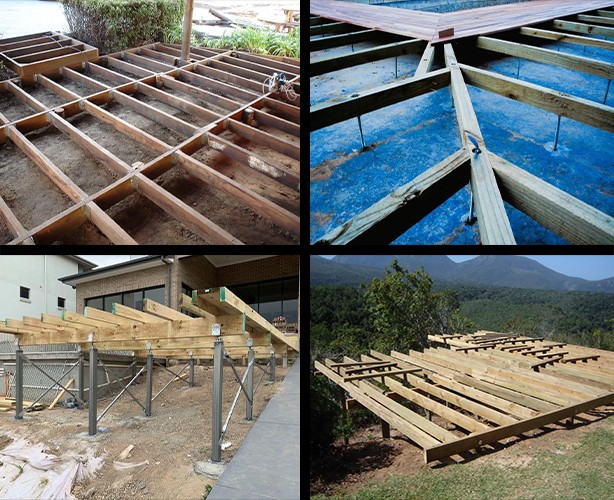
SUB STRUCTURE
H2 Internal (Low Hazard)
This is also for interior use only and timber treated under this classification should be roof trusses, laminated beams, internally used structural timber, ceiling boards, flooring, panelling, doors, cupboards, skirting, window frames and plywood. Chemicals used here would be mainly CCA, TBTNP and Boron.
H3 Exterior Above Ground (Moderate Hazard)
CCA and Creosote are mostly used for this and higher H class treatments. H3 covers balustrades, fencing bearers and slats, outdoor decking and beams, garden furniture, laminated beams, weather board, steps, cladding, stairs, log homes, gates, fascia boards and plywood. Spacers and cross arms used with electrical, distribution, telephone and light poles are treated to H3.
H4 Ground Contact (High Hazard)
This level of treatment helps prevent agricultural posts and landscaping structures from rotting and termite attack. Also recommended for treatment in this hazard class are playground structures, fencing, pergolas, carports, flower boxes, decking, bridges, and stakes, as well as electrical, distribution, telephone and lighting poles.
H5 Freshwater (High Hazard)
Timber which falls into this category, is timber exposed to continual wetting or where the timber is planted in wet soil. Timber which will fall into this category could be jetties, drains, walkways, retaining walls and slipways.
H6 Marine (High Hazard)
Only the use of the CCA chemical with Creosote is recommended for this application. Only timber treated with both these chemicals will offer complete protection against marine borders, jetties, slipways, retaining walls and walkways will fall under this section.
HOW TO PLANT A POLE
If a treated pole is planted in the ground, it is essential that you allow for drainage of rainwater through the timber.
Stand | |
|---|---|
If you plant the pole on concrete at the bottom of the hole, let the concrete set before planting the pole. | 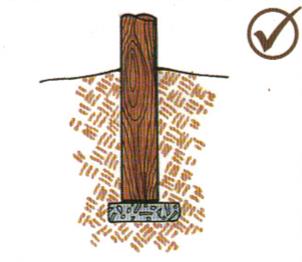 |
Collar | |
|---|---|
If you need to use concrete, then let the concrete form a collar around the pole with the end of the pole protruding through the concrete. | 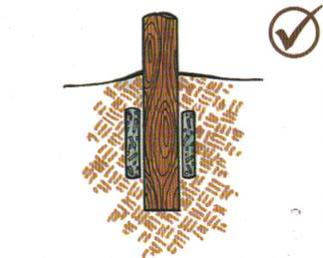 |
Cup | |
|---|---|
Do not enclose the planted end of the pole in the concrete, as it restricts drainage through the pole. | 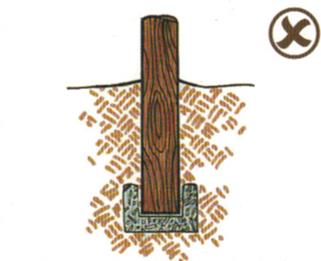 |
TIMBER STORAGE
Structural Timber stored on site should be stacked on level ground on bearers and should be adequately protected against the weather by being covered with a waterproof material. Air must be allowed to circulate through the timber stacks and strapping around bundles of battens should not be removed until the battens are to be fixed, to prevent excessive warping.
Substructure
Most deck structures will be constructed using CCA Treated H3 SA-Pine.
Most common application: Suspended Application
Sections available and used:
38X38; 38X76; 38X114; 38X152; 38X228; 50X76; 50X228
Legislation governing Timber Deck construction:
SANS 10163 – Governs structural use of timber
SANS 10082 – Timber Frame Building
SANS 10043 – Solid Wood Decking
Decks which are more than 1.5m off the ground, should be designed by an engineer with experience in timber construction.
Recommended Sub-structure spacing (+90mm widths):
Pine CCA Treated: max 500mm, 428mm recommended (divides into 3m 7 times)
Meranti Decking: max 450mm, recommended spacing to suite available length.
Balau Decking: max 500mm, 450mm recommended
Saligna Decking: max 500mm, 450mm recommended
Something to remember:
Sub-structure cost is much cheaper than deck covering. It is more economical to reduce centre spacing to accommodate decking length than to have huge offcuts on decking boards.
Maximum recommended safe span on timber structures:
Section: Max safe span, unsupported
38X114 CCA H3 1.000m
38X152 CCA H3 1.500m
38X228 CCA H3 2.200m
*Remember, these are guidelines only and should be checked with your engineer / truss department. *
WEATHERING
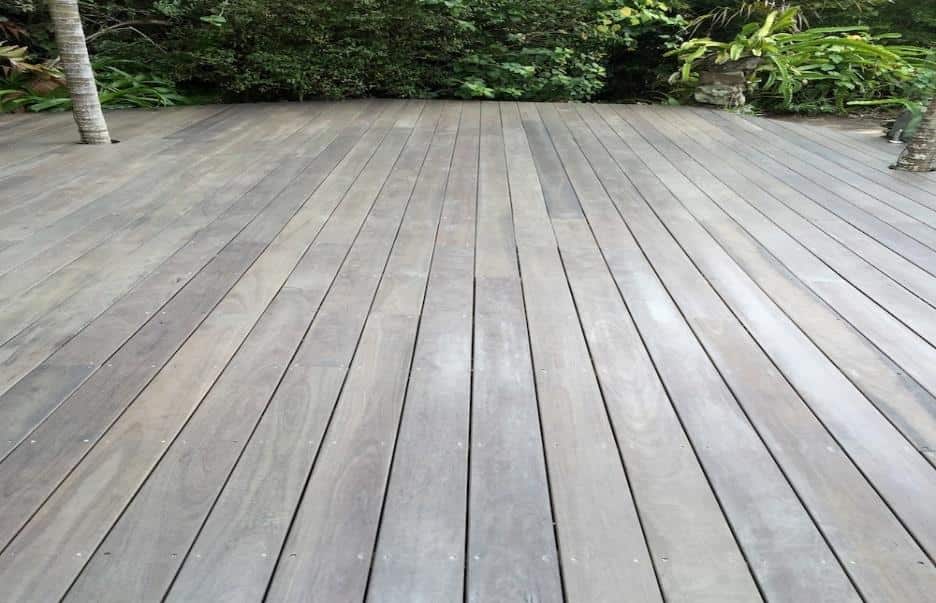
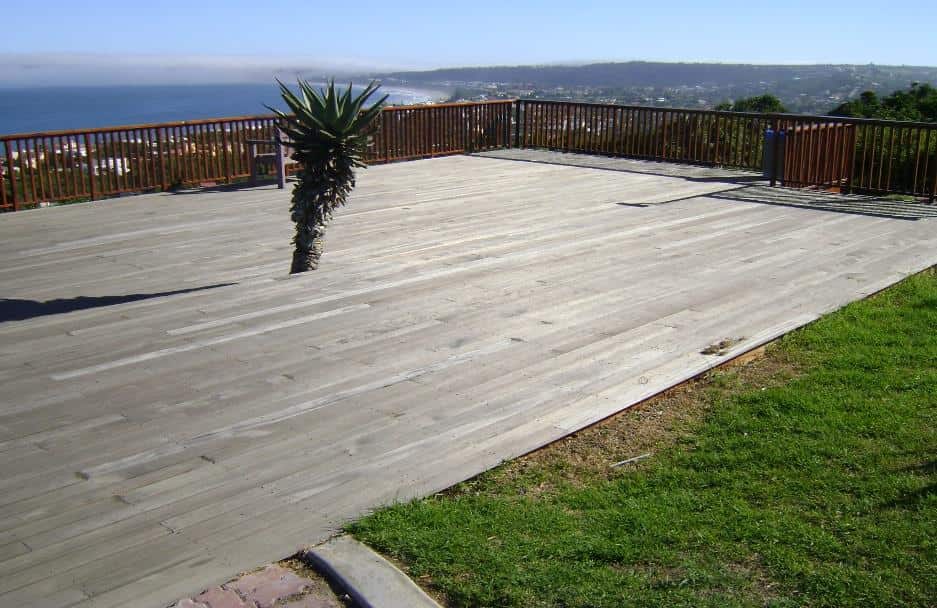
Outdoor weathering is a complex interaction of light, heat and moisture that rapidly alters the surface of timber.
It is observed as a change in colour, accompanied by a gradual loss of wood cells at the surface – the rate influenced by various factors. The amount of wood material is small e.g. for softwoods like Pine about 6mm of wood thickness weathers away every 100 years.
Initial signs of weathering and as it continues, a grey layer of 0.075 – 0.5mm thick starts to develop. All timber surfaces will eventually grey when exposed to the sun and moisture from rain and dew.
In addition to chemical and colour changes, mechanical damage occurs mostly because of moisture absorption – unfinished smooth timber surfaces become rough as the grain raises. Moisture content variations cause checks which can develop into large cracks.
SUMMARY
Decking installations: Important issues when installing timber decksThere are some important factors that MUST be adhered to, to achieve a long-lasting and successful deck installation:
A suitable type of decking timber should be able to cope with prolonged exposure to sun and water. Heavy, durable hardwood timber that is suited to marine applications is the preferred choice. These are timbers that have densities more than 800 kg when air dried. However, these tend to be expensive and alternatives, such as Saligna and CCA-treated pine, are also used.
Heavy hardwood timbers do not require long-term preservative treatment - they will withstand mould development as well as termite infestations. There are treatments available for decks and application thereof is often chosen for cosmetic purposes and may not substantially increase the durable qualities of the timber.
Varnish treatments should be avoided in ALL external timber treatments - oil-based preservatives should be chosen if a treatment is required.
Maintenance of timber with oil-based applications is easier. Varnish does not penetrate timber, thereby increasing the chances of timber degradation where timber becomes exposed to sun and rain...
Durable decking timber that is untreated will weather in time and the colour may deepen or, alternatively, turn to a silvery-white. These responses are species specific and do not reflect differences in durability.
The sub-structure of the deck is very important in determining the life of the deck. Suitably treated timber must be used (CCA, Creosote, etc.).
Remember that cut poles and bearers may expose untreated inner core timber, thereby enhancing rot or termite attack. Such exposed areas must be well-treated to seal against risk of rot or termite infestation. Design characteristics of the sub-structure must adequately cater for safety and load specifications.
ALL forms of timber have a natural tendency to "move" when exposed to differing climatic conditions. Heavy hardwoods that start to twist or warp are virtually impossible to re-align. Therefore, it is ESSENTIAL to attach decking correctly.
The five most important factors to follow to ensure that decking slats do not lift or twist once installed are the following:Use smooth-shank screws of non-rusting metal (Tip: Eureka Ruspert Deck screws or Stainless-steel screws ideal!)
Screws of at least 70mm length for 19mm decking slats are recommended - a minimum of 50mm bind into bearer is required
Holes must be drilled through the decking to accommodate the shank of the screw without the screw threads binding in the decking piece and avoiding the screw being too loose. The objective is for the screw to pull the decking firmly down onto the bearer - using clamps whilst screwing is ideal. (Tip: pre-drilling reduces chances of splitting, especially on deck ends!)
A minimum of two attachment points for each decking section per bearer (This reduces chances of cupping!)
Bearers must not be more than 450mm apart centre to centre, preferably 400mm to avoid twist or warp developing between bearers.
Allow for a 5mm (maximum) gap between slats to ensure the best overall appearance of the deck. (Tip: use a 100mm wire nail as spacer - diameter of 4" wire nail is 4.00mm - ideal spacing!)
REMEMBER - small cost differences translate into big differences in the life and maintenance cost of a deck.